

Summary
Figures are for students aged 17 or 18 in the second year of a school sixth form. The survey, providing the destination of these pupils on 31 October 2025, was in respect of 9,786 pupils completing Year 13 in 2025.
- Of the Year 13 cohort in 2025, 46.8% were male and 53.2% were female
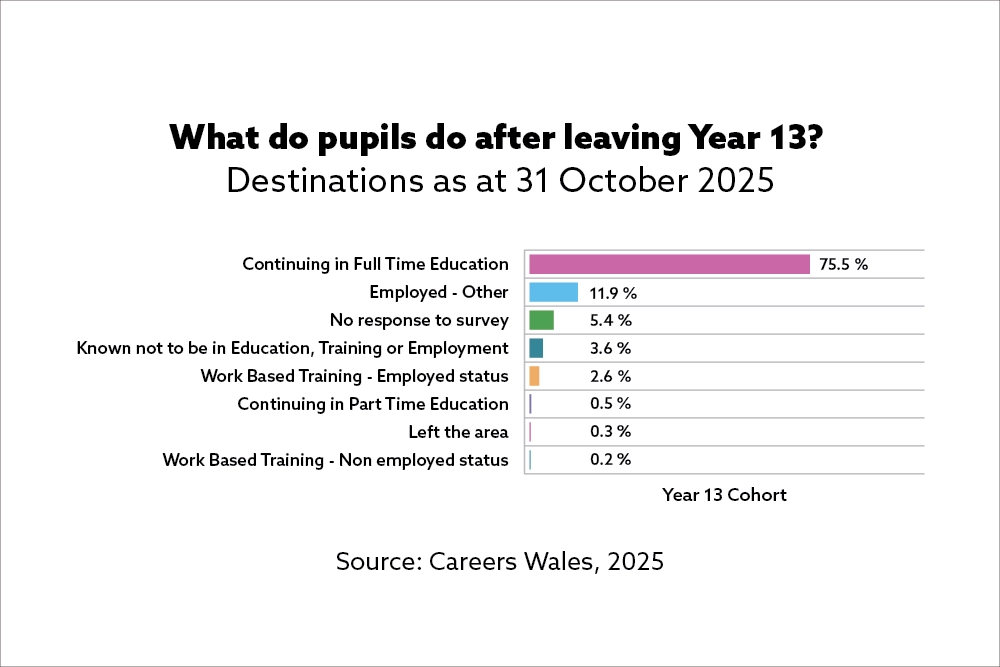
- 78.8% of the Year 13 cohort (7,711 individuals) went into some form of continued learning in education or work-based training. This represented a higher proportion of female pupils (81.4%) compared to male pupils (75.8%)
- 75.5% of the Year 13 cohort (7,392 individuals) continued in full time education (FTE). Of those 85.4% (6,316 individuals) progressed directly to higher education. This represented 64.5% of the total cohort
- In 2025, 89.3% of the Year 13 female cohort progressed directly to higher education compared to 80.5% of the male cohort
- Of those continuing within FTE, a lower percentage continued their education in school 6.1% (454 individuals) compared to those who continued at a further education college 7.7% (566 individuals)
- Of those continuing in education, 0.8% (56 individuals) stated that they were taking a gap year with the intention of going on to higher education the following year
- Continuing in part time education (16 hours or less per week) was the route taken by 45 individuals (0.5%)
- 14.7% of the Year 13 cohort (1,438 individuals) entered the labour market, either going into employment or work-based training
- 11.9% of the Year 13 cohort (1,164 individuals) entered employment outside of Government supported training, with 13.2% of males (603 individuals) and 10.8% of females (561 individuals) choosing this route
- A small proportion of the Year 13 cohort 0.2% (24 individuals) entered work-based training without employed status
- 2.6% of the Year 13 cohort (250 individuals) entered work-based learning with employed status. A higher percentage of males (3.8%) than females (1.5%) took this route
- On the survey date, 3.6% (356 individuals) of the Year 13 cohort were known not to be in any form of education, training, or employment (NEET). A higher percentage of males 4.6% (212 individuals) than females 2.8% (144 individuals) were classed as NEET
- The no response rate for the Year 13 cohort in 2025 was 5.4% of the cohort (529 individuals)
- 0.3% of the Year 13 cohort (26 individuals) of the cohort were shown to have left their local area
Year 13 Overall Figures
| Status | Male | % | Female | % | Other | % | Total | % |
|---|---|---|---|---|---|---|---|---|
| Continuing in Full Time Education | 3,261 | 71.2 | 4,130 | 79.4 | 1 | 50.0 | 7,392 | 75.5 |
| Continuing in Part Time Education (less than 16 hours a week) | 26 | 0.6 | 19 | 0.4 | 0 | 0 | 45 | 0.5 |
| Work Based Training - Non employed status | 13 | 0.3 | 11 | 0.2 | 0 | 0 | 24 | 0.2 |
| Work Based Training - Employed status | 173 | 3.8 | 76 | 1.5 | 1 | 50.0 | 250 | 2.6 |
| Employed - Other | 603 | 13.2 | 561 | 10.8 | 0 | 0 | 1,164 | 11.9 |
| Known Not To Be In Education, Employment or Training | 212 | 4.6 | 144 | 2.8 | 0 | 0 | 356 | 3.6 |
| No response to survey | 281 | 6.1 | 248 | 4.8 | 0 | 0 | 529 | 5.4 |
| Left the area | 13 | 0.3 | 13 | 0.2 | 0 | 0 | 26 | 0.3 |
| Total number in cohort | 4,582 | 100 | 5,202 | 100 | 2 | 100 | 9,786 | 100 |
Full Time Education (FTE)
| Gender | Percentage of students who stayed in Full Time Education |
|---|---|
| Male | 71.2% |
| Female | 79.4% |
| Status | Male | % | Female | % | Other | % | Total | % |
|---|---|---|---|---|---|---|---|---|
| Continuing to Year 14 in School of 11-18 schools | 286 | 8.8 | 168 | 4.1 | 0 | 0 | 454 | 6.1 |
| Year 13 school leavers continuing to colleges of Further Education | 330 | 10.1 | 236 | 5.7 | 0 | 0 | 566 | 7.7 |
| Year 13 continuing in Higher Education | 2,626 | 80.5 | 3,689 | 89.3 | 1 | 100 | 6,316 | 85.4 |
| Year 13 taking gap year with intention of going to Higher Education | 19 | 0.6 | 37 | 0.9 | 0 | 0 | 56 | 0.8 |
| Total | 3,261 | 100 | 4,130 | 100 | 1 | 100 | 7,392 | 100 |
Known Not To Be In Education, Employment or Training (NEET)
| Status | Male | % | Female | % | Other | % | Total | % |
|---|---|---|---|---|---|---|---|---|
| Able to enter Employment, Education or WBTYP | 80 | 37.7 | 58 | 40.3 | 0 | 0 | 138 | 38.8 |
| Unable to enter Employment, Education or WBTYP due to illness, pregnancy and other reasons | 132 | 62.3 | 86 | 59.7 | 0 | 0 | 218 | 61.2 |
| Total | 212 | 100 | 144 | 100 | 0 | 100 | 356 | 100 |
Ethnicity
Of those returning information on ethnicity:
- The most popular choice of route across those identifying as minority ethnic was continuing in FTE at 83.0%. This compared to 74.5% for individuals identifying as white
- A higher percentage of those identifying as white entered employment outside of Government sponsored training (12.6% of those identifying as white compared to 7.3% of those identifying as minority ethnic background)
- A higher percentage of those identifying as white entered work-based training–employed status (2.8% compared to 0.8% of those identifying as minority ethnic)
- The proportion of young people identifying as white who were classed as NEET was the same for those identifying as minority ethnic (3.6%). This represents 311 white individuals and 38 minority ethnic individuals
| Status | White | % | Minority Ethnic Groups | % | No information on ethnicity | % | Total | % |
|---|---|---|---|---|---|---|---|---|
| Continuing in FT Education (schools and colleges) | 6,387 | 74.5 | 876 | 83.0 | 129 | 83.2 | 7,392 | 75.5 |
| Continuing in Part Time Education (less than 16 hours a week) | 42 | 0.5 | 2 | 0.2 | 1 | 0.6 | 45 | 0.5 |
| WBTYP (without employed status) | 22 | 0.3 | 1 | 0.1 | 1 | 0.6 | 24 | 0.2 |
| WBTYP (employed status) | 240 | 2.8 | 8 | 0.8 | 1 | 0.6 | 249 | 2.5 |
| Employment | 1,079 | 12.6 | 77 | 7.3 | 9 | 5.8 | 1,165 | 11.9 |
| Known Not To Be In Education, Employment or Training | 311 | 3.6 | 38 | 3.6 | 7 | 4.5 | 356 | 3.6 |
| Unknown | 476 | 5.6 | 48 | 4.5 | 5 | 3.2 | 529 | 5.4 |
| Statutory School leavers who are known to have left the area | 19 | 0.2 | 5 | 0.5 | 2 | 1.3 | 26 | 0.3 |
| Total Number in Cohort | 8,576 | 100 | 1,055 | 100 | 155 | 100 | 9,786 | 100 |
| % of Total Cohort |
| 87.6 |
| 10.8 |
| 1.6 |
| 100 |
View other year groups

View the overall figures of Year 11 pupil destinations from schools in Wales 2025.

View the overall figures of Year 12 pupil destinations from schools in Wales 2025.