

Summary
Figures are for students aged 15 or 16 who were in their final year of statutory education, Year 11, in mainstream and special schools during the 2024-2025 academic year. The survey, providing the destination of these pupils on 31 October 2025, was in respect of 33,374 pupils who left compulsory education in 2025.
- Of the year 11 cohort in 2025, 51.6% (17,219 individuals) were male and 48.3% (16,133 individuals) were female
- Most of the cohort, 93.9% (31,350 individuals) went into some form of continued learning in full time education, part time education (16 hours or less a week) or work-based training. This represented 92.8% of males and 95.1% of female pupils
- The greatest proportion of the cohort, 88.7% (29,619 individuals) continued in full time education (FTE)
- Of those continuing in FTE, 61.7% continued at a further education college (18,272 individuals) and 38.3% (11,344 individuals) continued their education in school
- A higher proportion of males (64.2%) than females (59.1%), chose to continue their education at further education college - a difference of 5.1 percentage points
- A higher proportion of females (40.9%) than males (35.7%) chose to remain in school, a difference of 5.2 percentage points
- 7.3% of the Year 11 cohort (2,440 individuals) entered the labour market in 2025, either going into employment or work-based training. More males than females chose this route (8.6% males compared to 5.9% females)
- 3.4% of the Year 11 cohort (1,136 individuals) entered work-based training non-employed status in 2025
- 1.4% of the Year 11 cohort (453 individuals) entered work-based training with employed status in 2025. A higher proportion of males (2.0%) than females (0.7%) chose this route
- 2.5% of the Year 11 cohort (851 individuals) entered employment outside Government supported funding with more males (3.3%) than females (1.8%) choosing this route
- On the survey date, 2.1% of the cohort (711 individuals) were known not to be in any form of education, training, or employment (NEET). Males accounted for 57.5% of the total NEET figure (409 individuals) compared to females at 42.2% (300 individuals)
- Of those who were NEET in 2025, 33.3% (237 individuals) were able to enter employment, education, or training (EET) as opposed to the 66.7% (474 individuals) who were unable to enter EET due to illness, pregnancy, or other reasons
- The no response rate for the Year 11 cohort in 2025 was 0.8% of the cohort (275 individuals)
- 0.6% of the Year 11 cohort (187 individuals) were shown to have left their local area
Year 11 Overall Figures
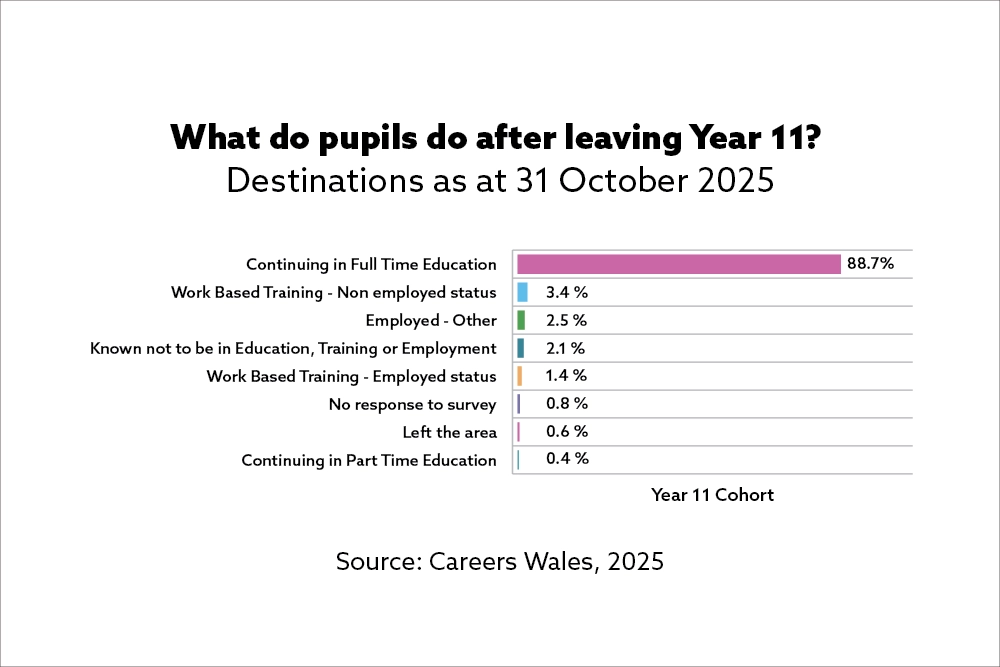
| Status | Male | % | Female | % | Other | % | Total | % |
|---|---|---|---|---|---|---|---|---|
| Continuing in Full Time Education | 14,975 | 87.0 | 14,627 | 90.7 | 17 | 77.3 | 29,619 | 88.7 |
| Continuing in Part Time Education (less than 16 hours a week) | 93 | 0.5 | 49 | 0.3 | 0 | 0 | 142 | 0.4 |
| Work Based Training - Non Employed Status | 570 | 3.3 | 564 | 3.5 | 2 | 9.1 | 1,136 | 3.4 |
| Work Based Training - Employed Status | 344 | 2.0 | 109 | 0.7 | 0 | 0 | 453 | 1.4 |
| Employed - Other | 567 | 3.3 | 284 | 1.8 | 0 | 0 | 851 | 2.5 |
| Known Not To Be In Education, Employment or Training | 409 | 2.4 | 300 | 1.9 | 2 | 9.1 | 711 | 2.1 |
| No Response to Survey | 170 | 1.0 | 104 | 0.6 | 1 | 4.5 | 275 | 0.8 |
| Left the Area | 91 | 0.5 | 96 | 0.6 | 0 | 0 | 187 | 0.6 |
| Total Number in cohort | 17,219 | 100 | 16,133 | 100 | 22 | 100 | 33,374 | 100 |
Full Time Education (FTE)
| Gender | Percentage of students who stayed in Full Time Education |
|---|---|
| Male | 87.0% |
| Female | 90.7% |
| Status | Male | % | Female | % | Other | % | Total | % |
|---|---|---|---|---|---|---|---|---|
| Continuing to Year 12 in School | 5,352 | 35.7 | 5,985 | 40.9 | 7 | 41.2 | 11,344 | 38.3 |
| Continuing to Year 12 in Colleges of Further Education | 9,620 | 64.2 | 8,642 | 59.1 | 10 | 58.8 | 18,272 | 61.7 |
| Year 11 continuing in Higher Education | 3 | <0.5 | 0 | 0 | 0 | 0 | 3 | <0.5 |
| Total | 14,975 | 100 | 14,627 | 100 | 17 | 100 | 29,619 | 100 |
Known Not To Be In Education, Employment or Training (NEET)
| Status | Male | % | Female | % | Other | % | Total | % |
|---|---|---|---|---|---|---|---|---|
| Able to enter Employment, Education or WBTYP | 145 | 35.5 | 92 | 30.7 | 0 | 0 | 237 | 33.3 |
| Unable to enter Employment, Education or WBTYP due to illness, pregnancy and other reasons | 264 | 64.5 | 208 | 69.3 | 2 | 100 | 474 | 66.7 |
| Total | 409 | 100 | 300 | 100 | 2 | 100 | 711 | 100 |
Ethnicity
Of those returning information on ethnicity from ethnic minority backgrounds:
- The most popular choice of route for those identifying as minority ethnic was continuing in FTE at 92.2% (compared with 88.3% for those identifying as white)
- A higher percentage of those identifying as white went into the various labour market categories (7.8%) compared to those identifying as minority ethnic (3.6%)
- Of young people who were NEET, a higher proportion identified as white (2.2% or 654 individuals) compared to individuals who identified as minority ethnic (1.6% or 51 individuals)
| Status | White | % | Minority Ethnic Groups | % | No information on ethnicity | % | Total | % |
|---|---|---|---|---|---|---|---|---|
| Continuing in Full Time Education (Schools and Colleges) | 26,360 | 88.3 | 2,854 | 92.2 | 405 | 91.6 | 29,619 | 88.7 |
| Continuing in Part Time Education (Less than 16 hours a week) | 130 | 0.4 | 10 | 0.3 | 2 | 0.5 | 142 | 0.4 |
| WBTYP (without employed status) | 1,059 | 3.5 | 69 | 2.2 | 8 | 1.8 | 1,136 | 3.4 |
| WBTYP (employed status) | 443 | 1.5 | 9 | 0.3 | 1 | 0.2 | 453 | 1.4 |
| Employment | 812 | 2.7 | 33 | 1.1 | 6 | 1.4 | 851 | 2.5 |
| Known Not To Be In Education, Employment or Training | 654 | 2.2 | 51 | 1.6 | 6 | 1.4 | 711 | 2.1 |
| Unknown | 254 | 0.9 | 18 | 0.6 | 3 | 0.7 | 275 | 0.8 |
| Statutory School leavers who are known to have left the area | 125 | 0.4 | 51 | 1.6 | 11 | 2.5 | 187 | 0.6 |
| Total Number in Cohort | 29,837 | 100 | 3,095 | 100 | 442 | 100 | 33,374 | 100 |
| % of Total Cohort |
| 89.4 |
| 9.3 |
| 1.3 |
| 100 |
View other year groups

View the overall figures of Year 12 pupil destinations from schools in Wales 2025.

View the overall figures of Year 13 pupil destinations from schools in Wales 2025.